How to Lubricate a Dremel Flex Shaft (225 & 9100 Guide)
A Dremel flex shaft makes detailed work much easier by transferring the motor’s rotation through a flexible cable to a lightweight handpiece. However, the internal cable spins at very high speed, and without proper lubrication the friction inside the sheath can quickly lead to heat, noise, and premature wear.
If you notice your flex shaft getting warm, making unusual sounds, or feeling less smooth during use, it may simply need fresh grease. Even if none of these symptoms are present, it is advisable to lubricate the shaft after a fixed time interval (which we will discuss in this article) to preserve its health.
In this guide, you’ll learn how to lubricate a Dremel flex shaft correctly, including the proper method for both the Dremel 225 Flex Shaft Attachment and the heavy-duty Dremel 9100 Heavy Duty Flex Shaft, the type of grease recommended by Dremel, and the common lubrication mistakes that can damage the handpiece or bearings.
Which Dremel Flex Shaft Do You Have? (225 vs 9100)
Before lubricating your flex shaft, it’s important to identify which model you are using. Dremel currently offers two main flex shaft attachments:
- Dremel 225 Flex Shaft Attachment (commonly used for home and DIY)
- Dremel 9100 Fortiflex Heavy Duty Flex Shaft
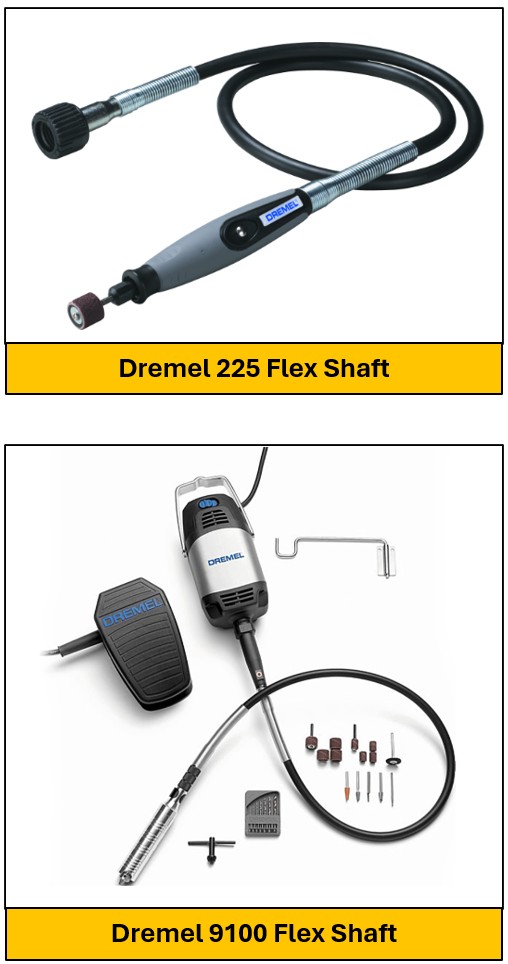
While both perform the same basic function—transferring rotary motion from the tool to a handheld spindle—their construction, intended workload, and lubrication intervals are different. Identifying your model ensures you follow the correct lubrication recommendations.
Why do the Dremel flex shafts need lubrication?
Both the Dremel 225 Flex Shaft Attachment and the Dremel 9100 Heavy Duty Flex Shaft rely on a long, tightly wound steel cable rotating inside a narrow protective sheath to transmit power from the rotary tool motor to the handpiece (as illustrated below).
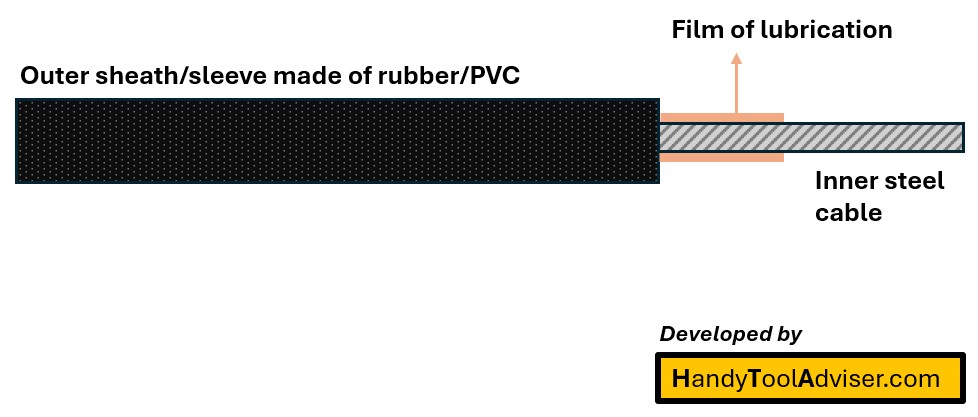
This cable can spin at tens of thousands of revolutions per minute while also bending along curves as you move the tool. Because of this design, the cable constantly rubs against the inner lining of the shaft housing, creating friction and heat during operation.
Lubrication forms a thin protective film between the rotating cable and the inner surface of the sheath, reducing metal-to-surface contact, lowering friction, and preventing premature wear. Without adequate grease, the friction generated at high RPM can quickly lead to overheating, increased vibration, and accelerated degradation of the cable and sheath.
When Does a Flex Shaft Need Fresh Grease?
Whether you are using Dremel 225 flex shaft or the Dremel 9100 heavy duty flex shaft, fresh grease will have to be applied under two conditions:
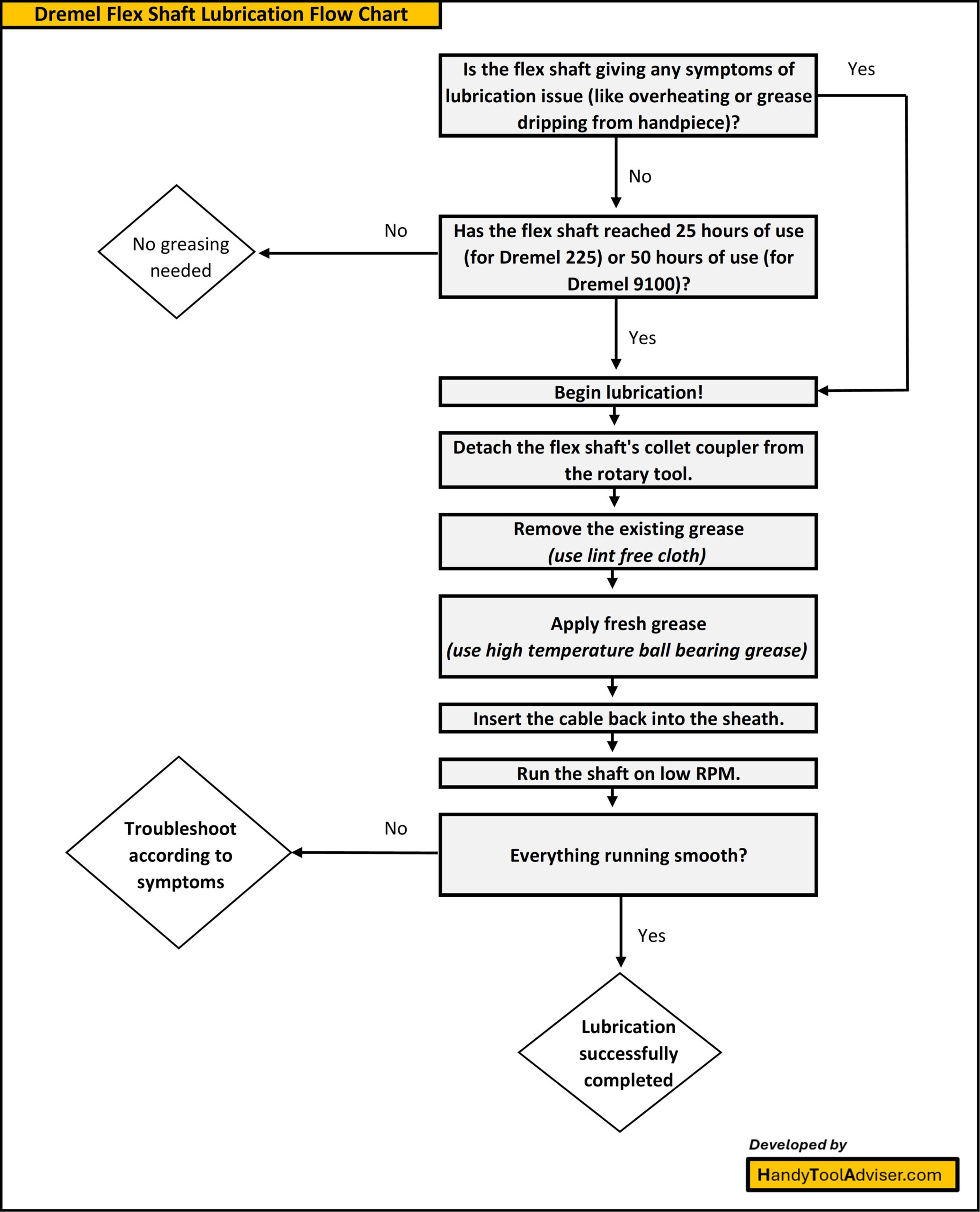
- Your flex shaft is giving symptoms that prompt you to perform a fresh lubrication. Common symptoms include excess heat, unusual noise, or a slightly rough feeling when the shaft rotates.
- Your flex shaft is not giving any noticeable symptoms, however, it has been in use for a certain time period and you are supposed to re-grease it as a proactive and preventive maintenance requirement.
The first condition is self-explanatory. However, let's discuss more about the second condition.
Official Lubrication Interval (OEM-Backed Data)
The most reliable guidance on flex shaft lubrication comes from the manufacturer itself. According to the user manual for the Dremel 225 Flex Shaft Attachment, the inner cable should be lubricated after approximately 25–30 hours of use using a thin film of normal bearing grease.
For the heavier-duty Dremel 9100 Heavy Duty Flex Shaft, the recommended lubrication interval as per the user manual is longer — around every 50 hours of operation — reflecting its more robust construction and heavier-duty design.
Interestingly, guidance published on the official channels of Dremel is not entirely consistent. The video description on Dremel’s official YouTube channel mentions lubricating the 225 flex shaft every 10 hours of use, which is more conservative than the interval stated in the manual.
The practical way to interpret this difference is that the 25–30 hour interval represents typical maintenance, while 10 hours is a safer interval for heavier workloads or prolonged high-speed operation. High RPM, tight bends in the shaft, and extended continuous use all increase friction and heat inside the sheath, which can break down grease faster.
In other words, the manufacturer’s data provides a useful baseline, but the actual lubrication frequency should also consider how intensively the flex shaft is used. Monitoring the condition of the grease and the operating temperature of the shaft can help determine whether lubrication should be done sooner than the nominal interval.
Dremel Flex Shaft Model | OEM Recommended Greasing Interval |
|---|---|
Dremel 225 | 25-30 hours |
Dremel 9100 | 50 hours |
Check the Color of Existing Grease
A quick way to judge whether your flex shaft needs fresh lubrication is to inspect the grease already coating the inner cable after you pull it out of the sheath. Fresh bearing grease typically appears light and uniform in color, often off-white, pale yellow, or light brown depending on the brand. It should form a smooth, slightly glossy film along the cable and feel slick to the touch. When grease is still in good condition, it maintains this even coating and shows no visible contamination.
As the flex shaft operates, the grease is exposed to high rotational speed, mechanical shear, and heat. Over time, these factors cause the grease to oxidize and pick up microscopic metal particles and dust from the rotating cable. This contamination gradually darkens the grease, turning it grey or brown. The coating may also start to look patchy or uneven along the cable, which indicates that the oil component of the grease is beginning to separate and its lubricating performance is declining.
If the grease appears very dark, dry, or clumped, it is a strong indication that it has degraded significantly. In some cases it may even look almost black or develop a slightly burnt smell due to thermal breakdown. At this stage, the lubricant can no longer maintain an effective protective film between the rotating cable and the inner surface of the shaft sheath. Continuing to run the flex shaft in this condition increases friction and heat, so the old grease should be cleaned off and replaced with a fresh, thin coat.
What Grease Should You Use?
Choosing the right lubricant for a Dremel flex shaft is more important than many users realize. Because the inner cable rotates at very high speed inside a narrow sheath, the grease must be able to stay in place, resist heat, and maintain a stable lubricating film under continuous mechanical shear.
Unfortunately, there is a lot of confusion online about what grease should be used. Some users recommend oils, others suggest specialty lubricants, and many assume the manufacturer sells a dedicated product specifically for flex shaft maintenance. To avoid damaging the shaft or the handpiece, it’s important to separate these opinions from the lubrication guidance that actually aligns with the design of Dremel flex shafts.
Does Dremel Sell a Special Flex Shaft Grease?
A common misconception is that Dremel sells a proprietary grease specifically designed for its flex shafts. In reality, there is no dedicated Dremel-branded grease product required for lubricating the flex shaft cable. The maintenance instructions provided by the manufacturer simply recommend applying a thin film of standard bearing grease to the inner cable during lubrication.
Part of this confusion comes from comparisons with other flex shaft brands, particularly those from Foredom. Foredom does sell its own specialized flex shaft grease for its tools, and many discussions about flex shaft maintenance online involve Foredom equipment.
As a result, some users mistakenly assume that a similar proprietary lubricant is required for Dremel flex shafts as well. However, the maintenance guidance for Dremel flex shafts does not require any brand-specific lubricant.
OEM Recommended Grease Type
According to the official documentation for the Dremel 225 Flex Shaft Attachment and the Dremel 9100 Heavy Duty Flex Shaft, the recommended lubricant is normal ball bearing grease or high temperature ball bearing grease applied as a thin, even coating on the inner cable. This type of grease is widely available and is commonly used in mechanical systems where rotating components require durable lubrication under load.
In practice, a standard high-temperature ball bearing grease works well because it maintains its lubricating properties under the heat and mechanical stress generated by the spinning cable. It has sufficient viscosity to stay on the cable rather than being thrown off by centrifugal force.
White Lithium Grease - A Suitable Alternative
Although Dremel recommends using standard ball bearing grease for lubricating the inner cable of its flex shafts, many experienced users and technicians report good results with white lithium grease as well. This lubricant is commonly used in mechanical assemblies where metal parts slide or rotate against each other under moderate load. Because it has good adhesion and temperature resistance, white lithium grease can maintain a stable lubricating film on the rotating cable inside flex shafts such as the Dremel 225 Flex Shaft Attachment and the Dremel 9100 Heavy Duty Flex Shaft.
Another reason white lithium grease is frequently suggested in forums and repair discussions is its balanced viscosity and clean handling characteristics. It is thick enough to stay on the cable during high-speed rotation but not so heavy that it creates unnecessary drag inside the sheath. In addition, its light color makes it easier to visually inspect grease condition during maintenance—darkening or contamination becomes more obvious when the cable is removed for re-lubrication. While it is not specifically listed in Dremel manuals, many users consider it a practical and widely available alternative that performs well when applied as a thin, even coating on the inner cable.
Lubricants NOT Recommended (Engineering Explanation)
Because a Dremel flex shaft operates with a high-speed rotating cable inside a confined sheath, the lubricant used must have the right balance of viscosity, adhesion, and thermal stability. Lubricants that are too thin can migrate away from the cable and contaminate other components, while those that are too thick can create drag and increase heat buildup.
For this reason, several commonly available lubricants that people often reach for are not suitable for flex shaft lubrication, even though they are widely used in other mechanical applications. Let's discuss some of these not-recommended lubricants.
WD40
Many users instinctively reach for WD-40 when they hear a mechanical component making noise or feeling rough. The product is widely marketed as a multi-purpose solution for loosening stuck parts, displacing moisture, and providing temporary lubrication. Because of this reputation, it’s easy to assume that spraying WD-40 into a Dremel flex shaft will solve friction or noise problems.
However, WD-40 is primarily a penetrating solvent with a very light oil component, not a true long-term lubricant. When applied to a flex shaft cable, the solvent quickly evaporates, leaving behind only a thin film that lacks the viscosity and film strength needed to protect a cable spinning at high RPM. This thin lubricant layer breaks down quickly under mechanical shear and heat, allowing metal-to-surface contact to occur again.
Motor Oil
Motor oil is another lubricant that users sometimes consider because it is a widely known and commonly available lubricant. One may also think that since engines operate at high RPM and high temperatures, it may seem logical that motor oil could also work for lubricating a flex shaft cable.
The problem is that motor oil relies on circulating lubrication systems to function properly. In an engine, oil is constantly pumped through passages, filtered, and redistributed to maintain a continuous lubricating film between moving parts. A flex shaft, however, is a sealed mechanical assembly without oil circulation, meaning the lubricant must remain in place on the cable itself.
Gun Oil
Some users also consider gun oil because it is designed for precision mechanical systems such as firearms. Firearm components operate under rapid motion and sometimes high temperatures, which can give the impression that gun oil might be suitable for other high-speed mechanical devices like rotary tool flex shafts.
However, gun oils are typically formulated to be very light, low-viscosity lubricants that spread easily across metal surfaces and provide corrosion protection. This property is beneficial in firearms, where moving parts must remain clean and lightly lubricated without attracting too much debris.
In a Dremel flex shafts, this same low viscosity becomes a disadvantage. The thin oil film cannot remain evenly distributed along the spinning cable and is quickly displaced by centrifugal force.
Lubricant Migration – Why It’s a Critical Concern
One of the most important reasons why certain lubricants (such as WD-40, Motor Oil and Gun Oil) are unsuitable for Dremel flex shafts is the phenomenon of lubricant migration. When the inner cable spins at high RPM inside the sheath, any lubricant that is too thin or low-viscosity can be thrown outward by centrifugal force or drawn along the sheath by capillary action. Over time, this causes the grease or oil to move from the cable toward the handpiece area.
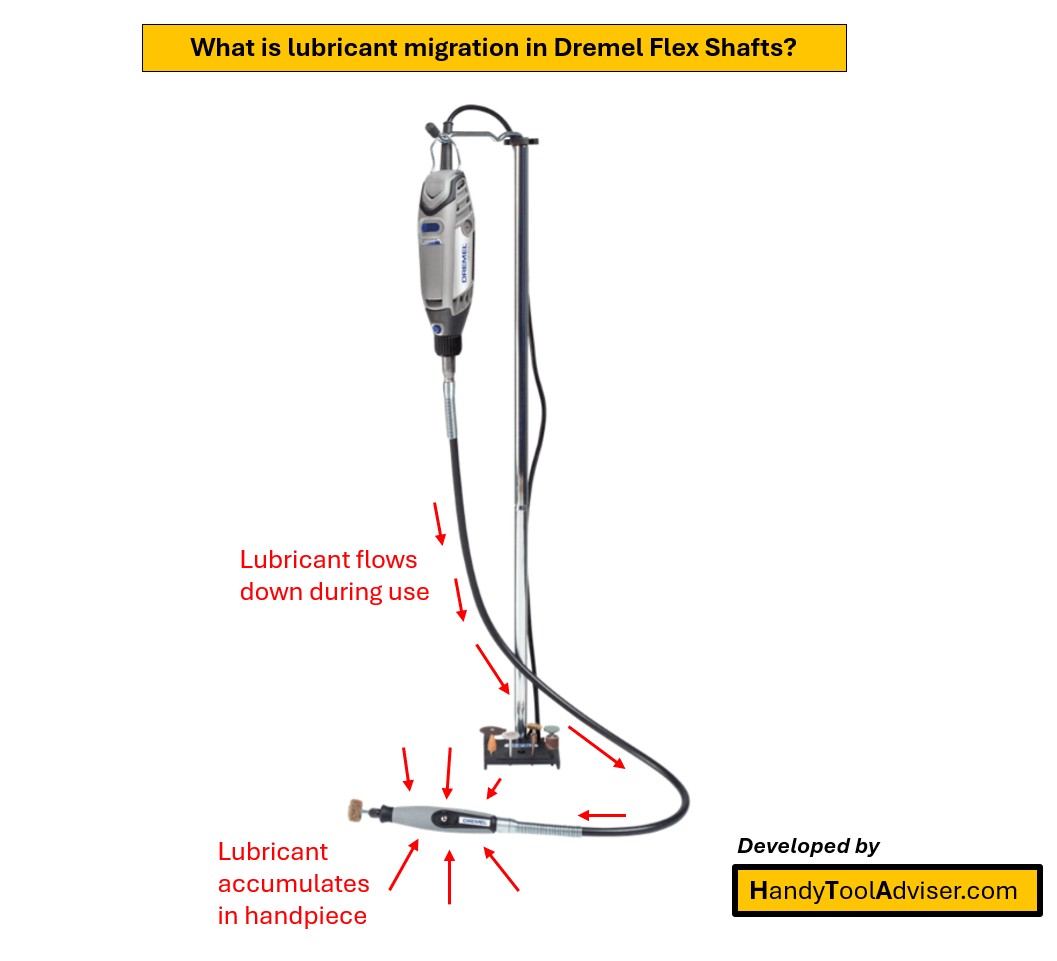
This is particularly problematic because the handpiece contains sealed or factory-lubricated bearings that are designed to last the life of the tool without additional lubrication. If migrated lubricant reaches these bearings, it can dilute or wash away the factory grease, reducing its effectiveness and potentially leading to overheating, increased wear, or premature failure.
Lubricant migration can also result in messy grease leaks, dripping onto the work surface or the material being worked on. This is one reason why manufacturers explicitly recommend applying only a thin, even layer of the correct bearing grease and avoiding low-viscosity oils such as WD-40, gun oil, or motor oil. Proper lubrication techniques minimize migration, keeping the protective film on the rotating cable where it is needed and preserving the integrity of the handpiece bearings.
Axle Grease
At the opposite end of the spectrum from thin oils is axle grease, which some users might assume is appropriate because it is designed for heavy-duty automotive applications. Axle grease is commonly used in wheel hubs and similar components where high loads and pressure are present.
The issue is that axle grease is typically much thicker and heavier than standard ball-bearing grease. Automotive axle lubricants are formulated to withstand extremely high pressures and loads found in vehicle drivetrains, often containing additives that increase viscosity and load-carrying capacity. While these properties are beneficial in wheel bearings and axle assemblies, they are not ideal for a small high-speed flexible cable.
In Dremel flex shafts, excessively thick grease can increase rotational resistance and generate additional heat as the cable spins inside the sheath. Instead of improving lubrication, it can make the shaft feel sluggish and reduce efficiency. This is why the manufacturer’s guidance favors normal or high-temperature ball bearing grease, which provides adequate lubrication without the excessive viscosity typical of many axle greases.
Do the Handpiece Bearings Need Lubrication?
Both the Dremel 225 Flex Shaft Attachment and the Dremel 9100 Heavy Duty Flex Shaft come from the factory with pre-lubricated sealed bearings that are designed to last the life of the tool under normal operating conditions. The manuals explicitly specify lubrication for the inner cable only and do not instruct users to apply grease to the bearings themselves.
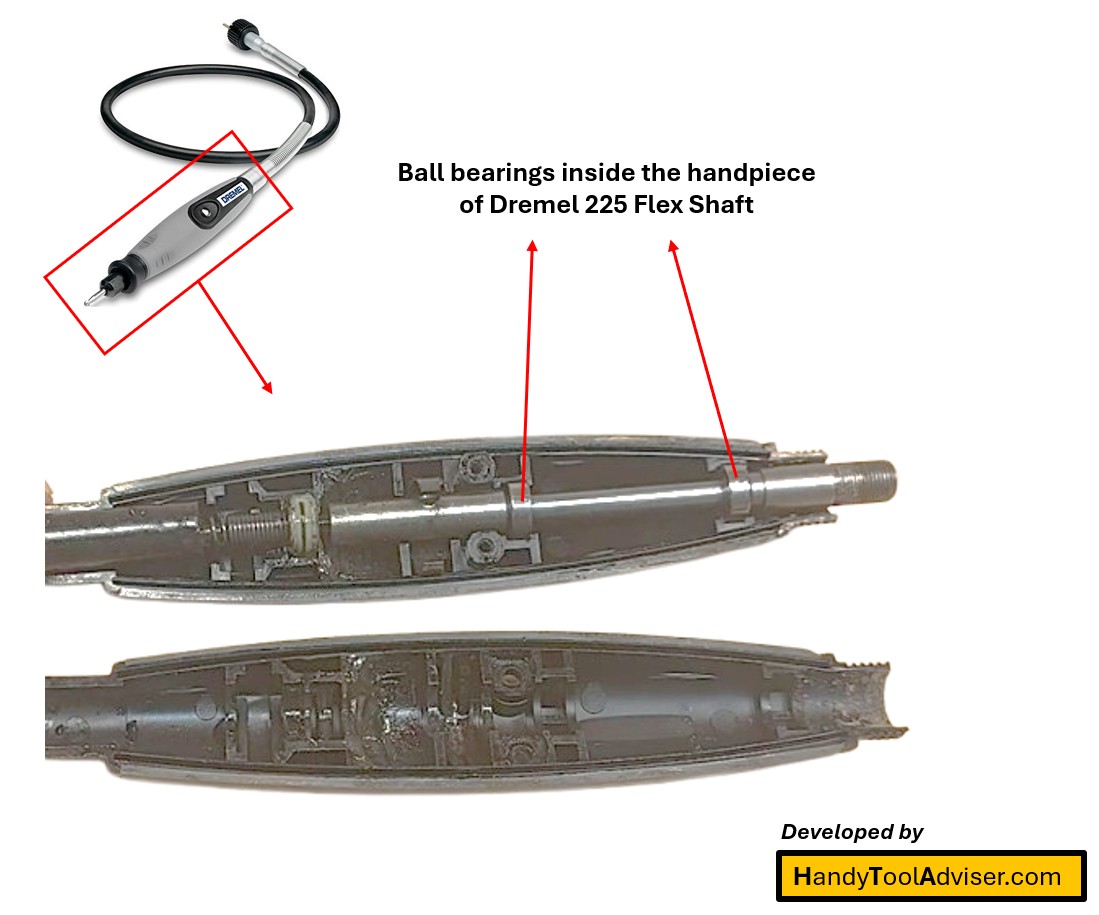
Adding grease or oil to the handpiece bearings can actually be detrimental, as it may interfere with the factory lubrication or attract contaminants. For example, low-viscosity oils or over-applied grease can migrate into the bearing races, reducing their lifespan and causing overheating during operation.
The key takeaway is that lubrication should only be applied on the inner cable and sheath, while the handpiece bearings should generally be left untouched unless a bearing replacement becomes necessary. This approach preserves the integrity of the tool and prevents common issues like grease contamination, bearing failure, or excessive heat buildup.
Step-by-Step Lubrication Process (With Pro Tips)
Follow these steps for both the Dremel 225 Flex Shaft Attachment and the Dremel 9100 Heavy Duty Flex Shaft.
Step 1 – Prepare Your Workspace
- Cover your table or bench with newspaper or disposable sheets to prevent grease from contaminating the surface.
- Avoid using towels or cloths with fur or lint, as fibers can stick to the inner cable or grease.
- Ensure the tool is disconnected from power and cooled down if recently used.
Step 2 – Remove the collet coupler
Detach the flex shaft's collet coupler from the Dremel rotary tool. Pull the coupler up to expose the inner cable/core.
Step 3 – Extract the Inner Cable
- Gently grip the exposed end of the inner cable on the end of the flex shaft that connects with the collet and pull it straight out of the sheath.
- It should slide out relatively easily — if it doesn’t, avoid forcing it, as bending or twisting can damage the cable or sheath.
- Check the video below for demonstration on how to pull out the inner core.
Step 4 – Clean Off Old Grease
- Wipe the cable with a lint-free cloth to remove excess grease.
- For more thorough cleaning, you can use kerosene, but it is critical to allow the cable to dry completely before applying fresh grease. Kerosene left on the cable can interact with heat and damage the shaft.
Step 5 – Apply Fresh Grease
- Apply a thin, even layer of normal bearing grease along the entire length of the inner cable.
- Avoid over-greasing, as excess grease can migrate down the sheath, clog the handpiece, drip onto your work, or cause overheating during operation (as already discussed earlier in the article).
- White lithium grease can be used as a practical alternative if standard bearing grease is not available, but it must also be applied sparingly.
Step 6 – Reinsert the Cable Carefully
- Slide the cable back into the sheath without twisting, bending excessively, or forcing it.
- Ensure the cable moves smoothly inside the sheath and does not bind.
- Check the video below for demonstration of how it's done.
Step 8 - Test at Low Speed
- Run the tool at low RPM initially to allow the grease to settle.
- Listen for unusual noises and monitor temperature. Gradually increase speed to normal operating levels if everything runs smoothly.
Pro Tips
- Use OEM lubrication intervals as a baseline (as discussed earlier in the article), but adjust based on actual use, workload, and observed grease condition.
- Never attempt to lubricate the handpiece bearings; the factory-sealed lubrication is sufficient for both 225 and 9100 models.
- Always monitor for signs of grease migration, overheating, or unusual friction, which indicate maintenance may be needed sooner.
Lubrication Flow Chart
Common Lubrication Mistakes That Damage Flex Shafts
Even with the right grease and intervals, improper lubrication can reduce performance or damage your Dremel flex shaft. While we've discussed these concepts earlier in this article, let's have a list of common mistakes to avoid:
- Over-greasing the inner cable – Excess grease can migrate down to the handpiece, clog the bearings, cause overheating, and drip onto your work.
- Using the wrong lubricant – Oils like WD-40, gun oil, motor oil, or heavy axle grease either migrate too easily or create excessive drag.
- Lubricating the handpiece bearings – Factory-sealed bearings in both 225 and 9100 models do not require additional grease; adding any can reduce bearing lifespan.
- Ignoring grease condition – Failing to check the color and texture of old grease can leave degraded lubricant in place, increasing friction and wear.
- Not cleaning the cable properly before applying new grease – Leaving old or contaminated grease, dust, or fibers can reduce lubrication effectiveness and damage the sheath.
- Using fur or lint-prone cloths – Fibers sticking to the cable or grease can interfere with smooth rotation and may accelerate wear.
- Applying lubricant when the cable is wet or kerosene hasn’t dried (if you've cleaned the inner core/cable with kerosene) – Residual solvents can react with heat during use, damaging the cable or sheath.
- Twisting or bending the cable during reassembly – Forcing the inner cable back into the sheath incorrectly can kink or damage it, creating friction points.
- Neglecting workspace protection – Not covering your bench can result in contaminated grease spreading, making cleanup harder and potentially contaminating the flex shaft itself.
These mistakes are common among DIY users and even technicians who overlook proper technique. Avoiding them ensures smoother operation, longer flex shaft life, and cleaner maintenance sessions.
Troubleshooting After Lubrication
Once your flex shaft is lubricated, make sure it runs smoothly without unusual noise, vibration, or overheating. These signs can indicate issues like over-greasing, a misaligned cable, or leftover debris in the sheath.
If the tool or flex shaft still gets hot or runs roughly, check out our guide on fixing Dremel overheating problems for tips on diagnosing the cause and keeping your flex shaft performing safely.
Related Articles
Affiliate disclosure: Handy Tool Adviser is reader supported. When you buy through our links, we receive a small commission at no additional cost to you.